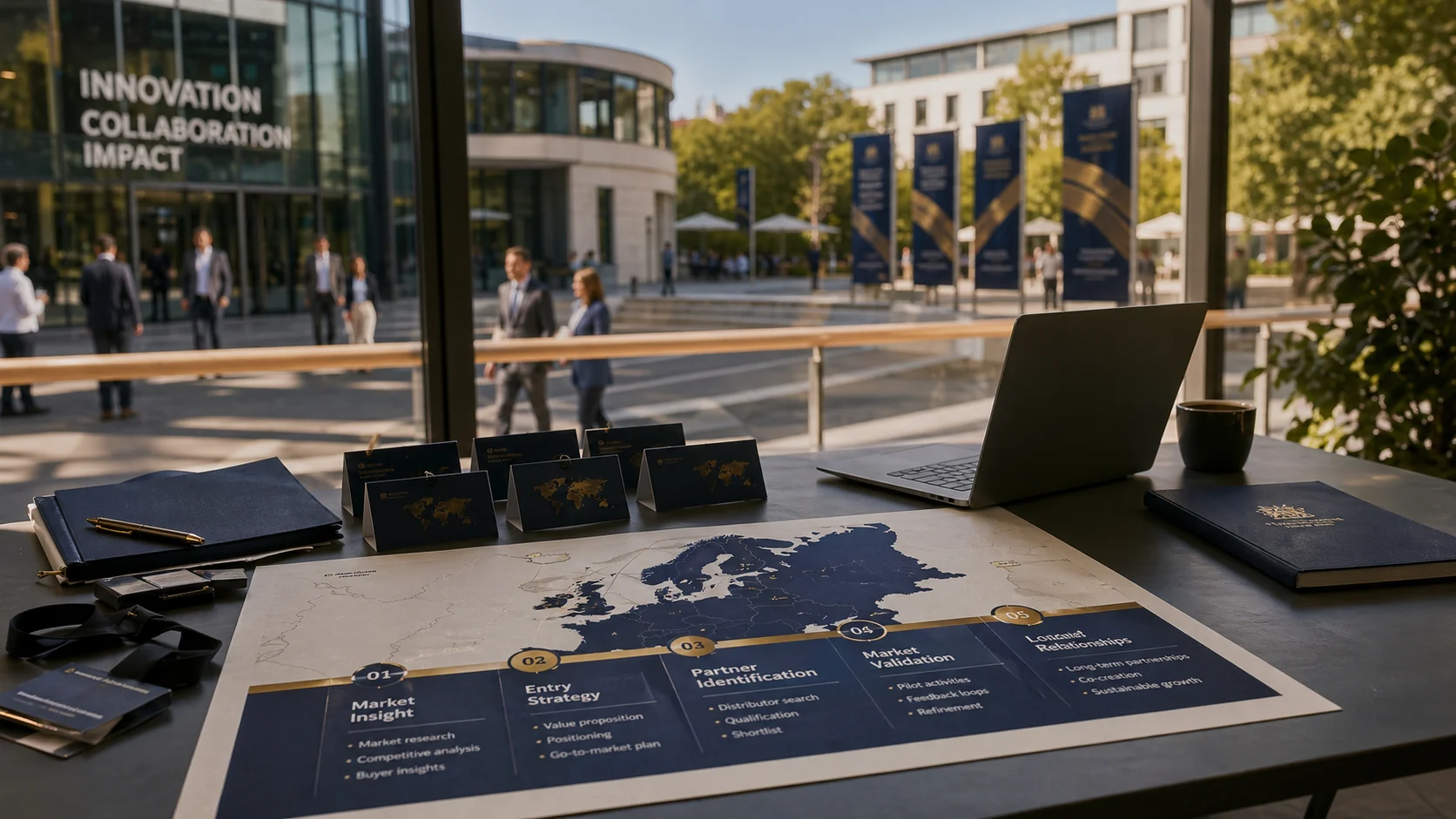
Market entry insight
European Business Partner Search for Japanese Companies: How to Move Beyond Cold Outreach
How Japanese companies can find, qualify, and meet trusted UK and European business partners through warm introductions and practical market-entry support.

For Japanese companies entering the UK or Europe, finding business partners is rarely a matter of building a contact list.
A distributor may look relevant on paper but lack access to the right customer segment. A well-known adviser may have strong credentials but little experience supporting Japanese companies. A trade show meeting may feel promising, then fade into polite follow-up with no commercial progress.
That is why European business partner search needs a structured, relationship-led approach. Japanese companies need to understand who is credible, who is relevant, and who is genuinely willing to engage before committing management time, travel budget, or market-entry resources.
Cold outreach can play a role. On its own, however, it is usually too weak to support serious Japan-Europe business development.
Why European Business Partner Search Is Different for Japanese Companies
Japanese companies often enter Europe with strong products, technical expertise, and domestic credibility. The challenge is that European decision-makers may not know the company, understand its track record, or immediately see why a conversation should be a priority.
In many B2B sectors, partnership decisions depend on local reputation, timing, sector fit, and trust. The question is not only, “Is this company good?” It is also, “Is this relevant to our market, customers, and commercial priorities right now?”
This makes generic outreach inefficient. A Japanese company may contact dozens of potential partners and receive little response, not because the opportunity is weak, but because the message lacks local context or arrives without a trusted reason to engage.
A better process reduces wasted meetings, unclear expectations, and stalled conversations after trade shows, business missions, or executive visits.

What Types of European Partners Should Japanese Companies Look For?
Before searching for partners, Japanese companies should define what kind of partner they actually need. “Business partner” can mean several different things in the UK and Europe.
Distributors and resellers can provide local sales coverage, customer relationships, and knowledge of specific countries or sectors. They are often useful when the Japanese company already has a product that can be sold through an established channel.
Strategic partners may support co-development, joint marketing, local credibility, or access to enterprise buyers, institutions, or technical ecosystems. These relationships are often more complex than simple sales partnerships.
Professional advisers can also be essential. Accountants, lawyers, localization specialists, recruitment advisers, and market-entry consultants can help Japanese teams understand tax, employment, regulatory, and operational requirements before making larger commitments.
Trade associations, chambers, event organizers, regional business groups, and investor networks can provide visibility and structured access to relevant contacts.
The right partner type depends on the company’s stage. A business validating demand needs different support from a company searching for distributors, planning an investment, hiring locally, or building long-term representation.
Why Cold Outreach Alone Often Fails in Europe
Cold outreach often fails because it starts with too little trust and too little context.
A purchased or manually built contact list rarely shows whether a person has decision authority, sector relevance, geographic coverage, or interest in Japan-related opportunities. Even when the contact is accurate, the timing may be wrong.
European companies are also likely to ignore messages that do not clearly explain the Japanese company’s product, proof, market fit, and reason for contact. A general introduction can sound courteous but still fail to answer the commercial question: why should this person take a meeting?
Language and business etiquette can create additional friction. Messages may sound too formal, too vague, or too light on practical detail for local expectations. A company may explain its history and philosophy but fail to make the partnership opportunity clear.
Even when a meeting is secured, the opportunity can fade without structured qualification, interpretation support, and disciplined follow-up.
Cold outreach can also damage credibility if the company approaches unsuitable partners or begins conversations before it has a clear European value proposition.
What a Better European Partner Search Process Looks Like
A stronger partner search starts before outreach.
Japanese companies should define target countries, priority industries, partner roles, buyer segments, and the commercial outcome expected from the search. A company looking for market feedback in the UK should not use the same process as a company trying to appoint distributors across several European countries.
The next step is to build a qualification profile. This should cover sector experience, customer access, geographic reach, reputation, language capability, responsiveness, and willingness to work with a Japanese company.
Trusted introducers, local networks, business communities, and event relationships can then be used to identify contacts who are more likely to take the conversation seriously.
Before approaching candidates, prepare a concise English company introduction, product or service explanation, partnership objective, and meeting agenda. The goal is to make it easy for the other side to understand the opportunity and decide whether the meeting is worth their time.
Finally, track each contact like a pipeline. Useful stages include identified, introduced, qualified, meeting completed, follow-up agreed, commercial discussion, and rejected. This keeps the search practical and prevents relationship activity from becoming unstructured networking.
How to Qualify Potential UK and European Business Partners
A good partner search is not measured by the number of introductions. It is measured by the quality of the relationships that survive qualification.
Start by checking whether the potential partner has experience with similar products, industries, customer sizes, or cross-border relationships. Ask where they have been successful before and what kinds of companies they usually support.
For distributors or sales partners, ask about their current customer base, sales channels, decision-making process, geographic coverage, and whether they already represent competing solutions.
For advisers or market-entry partners, ask how they support foreign companies, what process they follow, and how they handle communication between Japanese leadership and local stakeholders.
Communication quality matters. Response speed, clarity, transparency, and the ability to explain local market conditions are all useful signals. A partner who is vague before the relationship starts may become difficult to manage later.
Look for evidence such as client examples, event participation, references, case studies, partner logos, leadership background, and community reputation. If names cannot be shared for confidentiality reasons, ask for anonymized examples.
Most importantly, separate polite interest from commercial fit. A useful question is: what would need to be true for this partner to invest time, introductions, or sales effort?
The Role of Warm Introductions in Japan-Europe Business Development
Warm introductions help Japanese companies bypass the lowest-trust stage of outreach.
When an introduction comes from a credible source, the European contact has a clearer reason to engage. The introducer can explain both sides’ context, reduce misunderstanding, and help set expectations before the first meeting.
But warm introductions should be targeted, not generic. The introducer should understand the Japanese company’s goals and the European contact’s relevance. An introduction without a clear rationale is only slightly better than a cold email.
A strong introduction usually includes a short explanation of the Japanese company, the reason the European contact is relevant, the mutual benefit, and a suggested next step. It may also include cultural, timing, or confidentiality considerations.
The best networks also help after the introduction. Meeting coordination, interpretation, follow-up, and next-step prioritization can be just as important as the first contact.
How Japanese Companies Can Prepare for a First Europe Partner Meeting
Preparation has a direct impact on whether a first meeting becomes a real opportunity.
Japanese companies should prepare a short English company overview, product or service summary, target customer description, partnership objective, and proof of domestic traction. This does not need to be a long presentation. It needs to be clear.
The company should also decide what it wants from the meeting. The goal may be market feedback, distributor interest, customer introductions, event participation, a joint proposal, or a second technical discussion.
Bring practical questions. Ask about local demand, competitors, pricing expectations, regulatory barriers, buying cycles, and decision-maker access.
It is also important to decide who will lead the meeting, who will interpret or clarify cultural nuances, and what information can be shared under confidentiality constraints.
The meeting should end with agreed next steps, owners, timeline, and follow-up materials. “Let’s stay in touch” is not enough.
Common Mistakes Japanese Companies Make When Searching for European Partners
One common mistake is searching too broadly. Europe is not a single market. A company with limited time and budget should prioritize countries, sectors, and partner types that match its near-term capacity.
Another mistake is assuming that the largest or most famous organization is automatically the best fit. A large distributor, well-known adviser, or prestigious network may not be right for the company’s stage, product category, or target customer.
Many companies also attend events without a pre-arranged meeting plan, introduction strategy, or follow-up system. Events can be useful, but only when they are connected to a broader partner search process.
Bilingual communication alone is not enough. A partner may speak Japanese or English well but still lack real commercial access, sector credibility, or the ability to create opportunities.
Finally, Japanese companies sometimes provide too little practical information. European contacts need enough detail to evaluate whether a partnership is worth pursuing.
How a Japan-to-Europe Business Network Can Support the Search
A Japan-focused Europe network can help companies understand which contacts are relevant before spending time on meetings or travel.
Support may include market context, partner identification, trusted introductions, business visit planning, event access, interpretation, and post-meeting follow-up.
For Japanese SMEs and mid-market companies, this can be a practical bridge before committing to a local office, permanent hire, or full market-entry program. It allows leadership to test assumptions, meet credible contacts, and understand the market with less uncertainty.
For trade associations, regional banks, and local government groups, a Europe-facing network can provide member companies with structured access to business contacts and events.
TMC World Network helps Japanese companies build trusted business relationships and explore growth opportunities across the UK and Europe. For teams that need local context, relevant introductions, and practical support before making larger commitments, a relationship-led network can be a useful first step.
What Proof Should You Look for Before Choosing a Partner Search Provider?
Before choosing a partner search provider, Japanese companies should ask for evidence.
Look for leadership bios, sector experience, Japan-Europe business background, partner organizations, member examples, event history, testimonials, and case studies.
Request examples of successful introductions, business missions, distributor searches, or market-entry support. If company names cannot be shared, anonymized examples can still show the provider’s process and relevance.
Ask how the provider qualifies contacts, decides when an introduction is appropriate, supports communication, and handles follow-up. A credible provider should be able to explain its method clearly.
Confidentiality also matters. Japanese executives and European stakeholders may have different expectations about information sharing, meeting style, and decision timelines. The provider should be able to manage those differences carefully.
A good first step is usually a consultation, target market discussion, introduction request, or scoped partner search plan.
When Should a Japanese Company Start a European Partner Search?
The best time to start is before there is pressure to deliver meetings quickly.
If a company is preparing for a trade show, executive visit, business mission, or board presentation, the search should begin early enough to identify and qualify targets before travel plans are fixed.
A partner search can also be useful when domestic growth is slowing and leadership needs realistic overseas options supported by local market context.
If inbound interest from Europe appears, a structured search can help the Japanese company understand whether the contact is credible, whether the market is attractive, and how to respond professionally.
A partner search is also useful after a previous expansion attempt stalled due to weak introductions, unclear communication, or unsuitable partners.
Early-stage companies do not always need a full market-entry program. A lighter search can help validate demand before investing in localization, hiring, or a European office.
How to Turn European Contacts Into Real Business Opportunities
Partner search should be treated as a pipeline, not a one-time networking activity.
Define target profiles. Qualify contacts. Schedule meetings. Document feedback. Prioritize follow-up. Review what the market is telling you after each round of conversations.
Warm introductions can improve response quality, but qualification criteria should decide which relationships deserve more investment.
The goal is to turn promising conversations into concrete next steps: sample evaluation, customer introductions, distributor discussions, pilot projects, event participation, or a second executive meeting.
For Japanese companies exploring the UK and Europe, the right bridge can make the process more focused and less uncertain. With relevant introductions, clear preparation, and disciplined follow-up, unknown contacts can become warmer relationships, better market insight, and more credible expansion opportunities.
If your team is preparing for a UK or European partner search, TMC World Network can help you clarify target markets, identify relevant contacts, and plan the next practical step toward trusted business relationships.
Related reading